
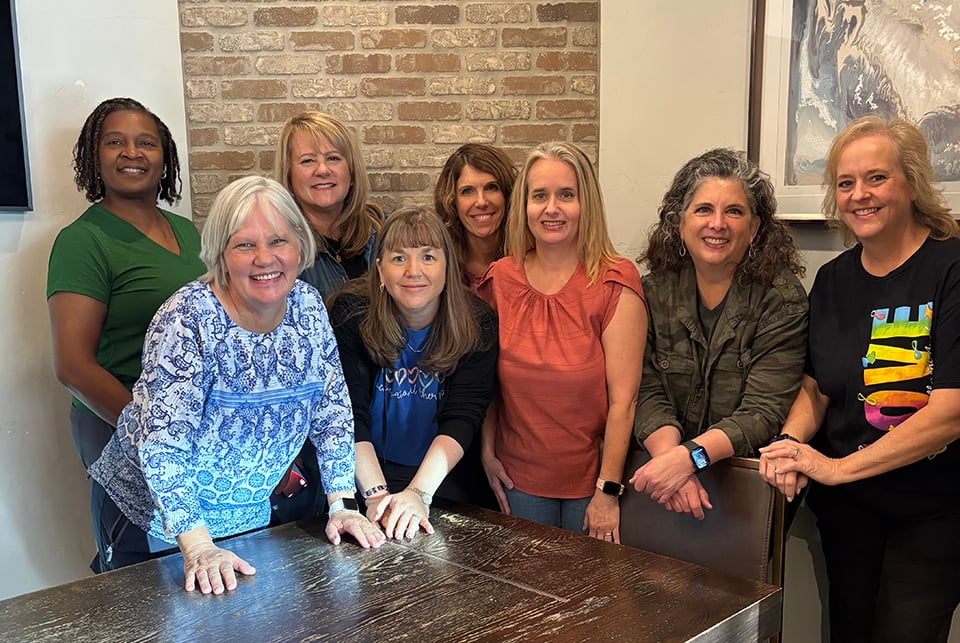
April is National Occupational Therapy Month, making it the perfect time to recognize an incredible group of professionals in Arlington ISD who often work behind the scenes to support students every day. While their work may not always be visible, its impact is felt in classrooms, homes, and throughout students’ lives.
Occupational therapists (OTs) help people of all ages develop, recover, and maintain the skills needed for daily living and learning. In a school setting, that means helping students build the physical, cognitive, and emotional abilities they need to succeed.
“Occupational therapists assess physical, cognitive, and emotional abilities, then create personalized treatment plans to improve independence and quality of life,” said Gretchen Foster, an Arlington ISD occupational therapist. “This can include helping patients regain motor skills after injury, teaching adaptive techniques for tasks like dressing or cooking, recommending assistive devices, and modifying home or work environments for safety and accessibility. They also support individuals with developmental disabilities, mental health conditions, or chronic illnesses by building coping strategies, improving social participation, and enhancing overall functioning in everyday activities, including school.”
In other words, occupational therapy is about helping students fully participate in their world.
And despite the name, occupational therapy isn’t just about jobs or careers.
“Occupational therapy is more than ‘work,’” said Karen McCarthy, another Arlington ISD occupational therapist. “To an OT, occupations are any meaningful activities a person wants or needs to do, including playing, being a student, socializing or working.”
That’s why play is often a key part of what OTs do with students – but it’s never “just play.”
“I often have people ask me about being able to play with kids all day,” said Lori Walsh, an Arlington ISD OT. “But the play is with a purpose. Occupational therapists use activity analysis to decide what tasks to work on and how the tasks are implemented. There is a science behind the planning that involves looking at a child’s abilities and needs, what the overall objectives are, and what activities are motivating or important to the child.”
This thoughtful, individualized approach allows OTs to meet students where they are and help them build skills in ways that feel meaningful and achievable.
One example of this is a strategy called backward chaining.
“As OT’s we sometimes use backward chaining to teach complex tasks,” said Arlington ISD OT Debra Lantz. “Instead of teaching a skill from the beginning, we have the person complete only the final step first – then gradually add earlier steps over time.”
For example, when teaching a child to put on a shirt, the therapist might first have the child pull the shirt down at the end. Later, the child learns to put their arms in the sleeves. Eventually, they master the entire sequence.
“This works because the person experiences immediate success – they finish the task,” Lantz explained. “It builds confidence and motivation and is especially helpful for kids or individuals with cognitive or neurological challenges.”
From improving fine motor skills and handwriting to supporting sensory needs, social participation and independence, Arlington ISD’s occupational therapists play a vital role in helping students thrive.
This month, we celebrate their expertise, their creativity, and their dedication to ensuring every student has the tools they need to succeed – not just in school, but in life.
Thank you, Arlington ISD OTs!