
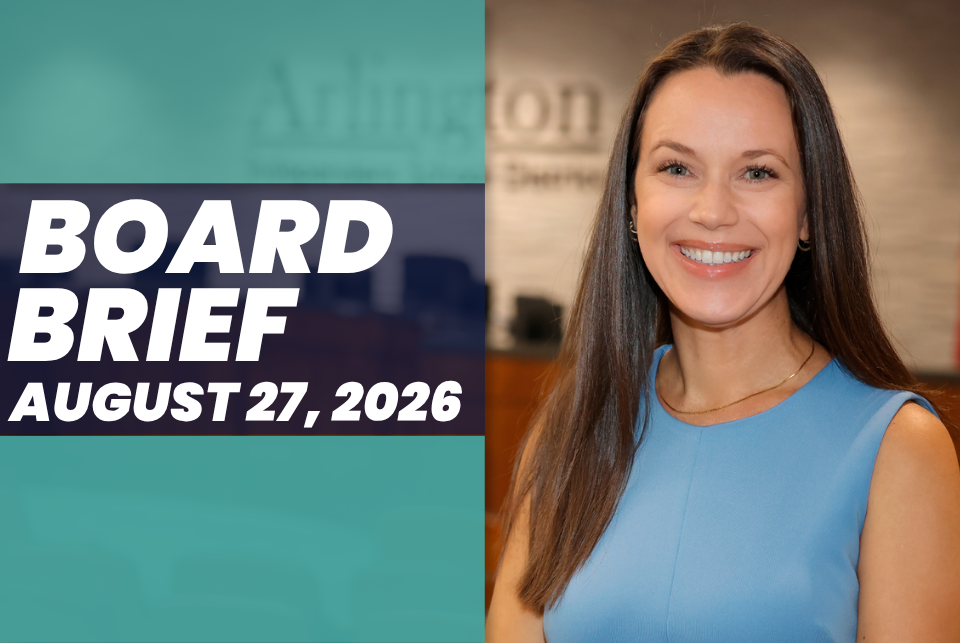
The Arlington ISD Board of Trustees gathered for its second monthly meeting last night, Aug. 27, 2026, and here are some of the highlights.
They began the evening with a board workshop on academic growth, where they took a comprehensive look at the academic trends in the district. They reviewed data from last year for early literacy, early numeracy, reading, math, science, and social studies. They also examined accountability ratings and the relationship between student achievement scores and academic growth scores. The important conversation was intentional to help everyone plan for the future and implement effective improvement efforts.
Once in the open session, the board appointed Andrew Babcock as the district’s new executive director of fine arts. He’s been the interim director since March and previously served as the director of the Center for Visual and Performing Arts.
Back in July, the board approved charters for three community committees:
- the Citizens Bond Oversight Committee,
- the Long-Range Facilities Planning Committee,
- and the Community Ambassador Academy.
All of them are intended to build bridges with our community stakeholders and garner their input and guidance. At last night’s meeting, several district administrators shared an update on these committees and their meeting schedules for the year.
South Davis Elementary is getting a new campus, funded by the 2026 Bond. Last night, the board approved the schematic design for the new school after a presentation from Corgan, the architect. Now Corgan will begin design development. It’s going to be a beautiful school and is scheduled to open in August 2028.
Later, the trustees handled a number of financial items, including approving the monthly financial report through June and the Quarterly Investment Report through June.
Finally, the board re-approved Arlington ISD’s participation in the Texas Virtual School Network, which offers interactive online courses for eligible Texas public school students. For over 10 years, Arlington ISD has made TXVSN available as an option for students in grades three through 12 for credit recovery or acceleration.
Those are just a few of the highlights from the meeting. If you would like more information on any of these items or any of the items not covered in this Board Brief, watch the entire meeting here.